VicPD officers make up to $108,000 in overtime
While VicPD is asking for an $11 million, 14% budget increase in 2026, new FOI data shows that from 2022 to 2024, 48 VicPD officers made over $50,000 in overtime in a single year, with two constables pocketing over $100,000 in extra pay in 2022.
Officer salaries and OT payouts
This FOI and story were directly inspired by Liam Britten’s work for CBC on the Vancouver Police Department’s OT figures, which are even higher. He framed his piece by drawing comparisons to Vancouver officers’ base pay.
A VicPD constable’s salary starts at $85,000 in the first year, rising to $122,000 by year five, and capping out at $140,000 in year twenty.
Thanks to a previous FOI, we know that in 2024, only 13% of officers had reached the top of the pay grid. But because of OT, the average constable actually made $144,000, more than the base pay of those 20-year officers.
The average compensation for all VicPD officers in 2024, including OT, was $156,000. We now know that the average OT payout that year was $20,447.
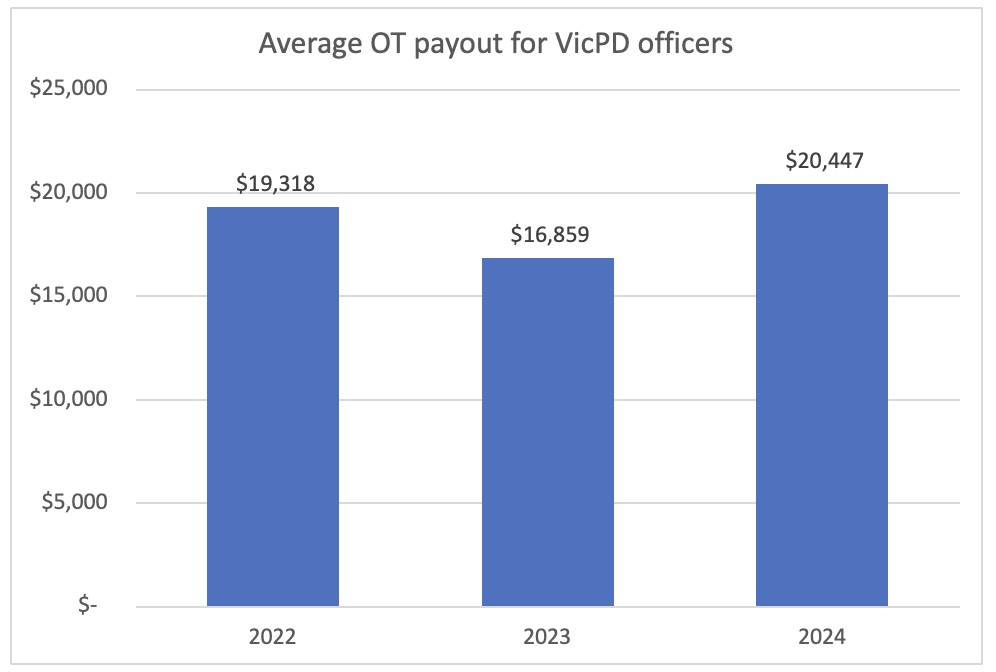
Average payout for VicPD officers who were paid overtime, 2022 to 2024.
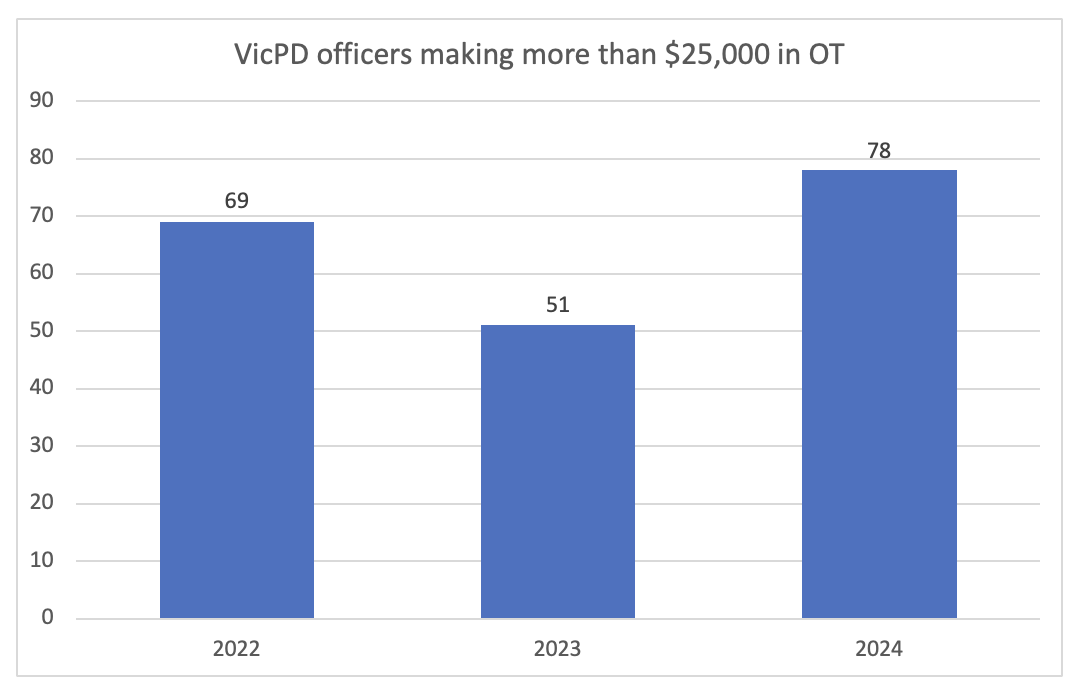
In 2022, VicPD had 69 officers who made more than $25,000 in OT. In 2024, there were 78. Officers earning more than $50,000 in overtime increased from 18 to 19 in the same period.
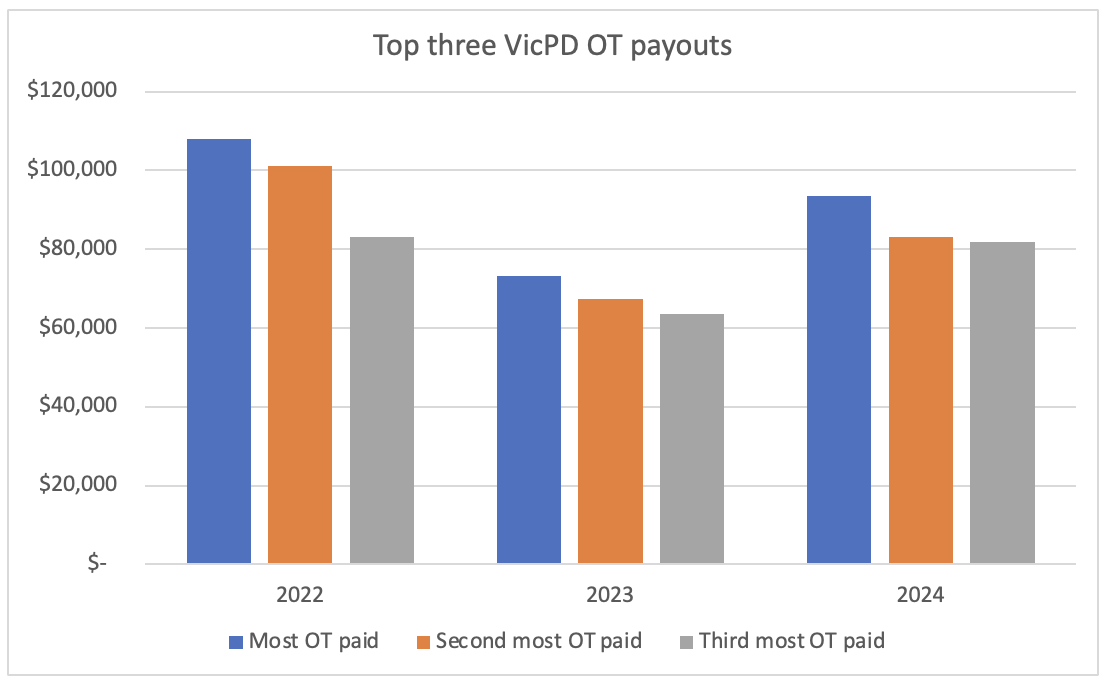
Last year, VicPD’s top OT earners were a fifth-year constable who took home $93,000 in OT; a first-year sergeant who made $83,000 in OT; and a 15-year constable who made $82,000 in OT.
And in 2022, one 20-year constable made $101,000 in overtime, while a 10-year constable took home $108,000.
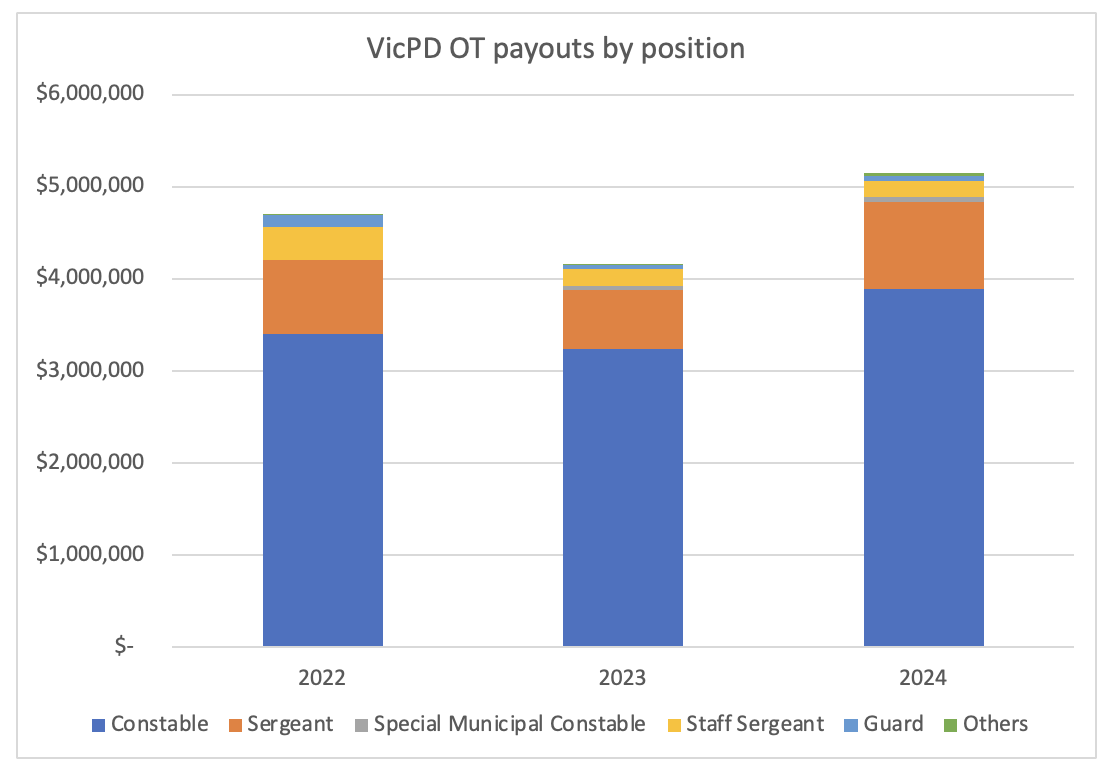
In order to facilitate a comparison for anyone who’s interested, this post replicates some of the stats Liam Britten chose to highlight in Vancouver, including the graph above. And this one!
They might have made even more
All of VicPD’s OT payouts to officers should be treated as a minimum, because VicPD’s budget documents show it spends even more on overtime each year.
According to VicPD’s budget documents, VicPD paid out $5.1 million in OT in 2022 and $4.8 million in 2023, jumping to $6.4 million in 2024. But that’s $384,000 (8%), $652,000 (16%), and $1.3 million (25%) higher than the total OT payouts they disclosed via FOI.
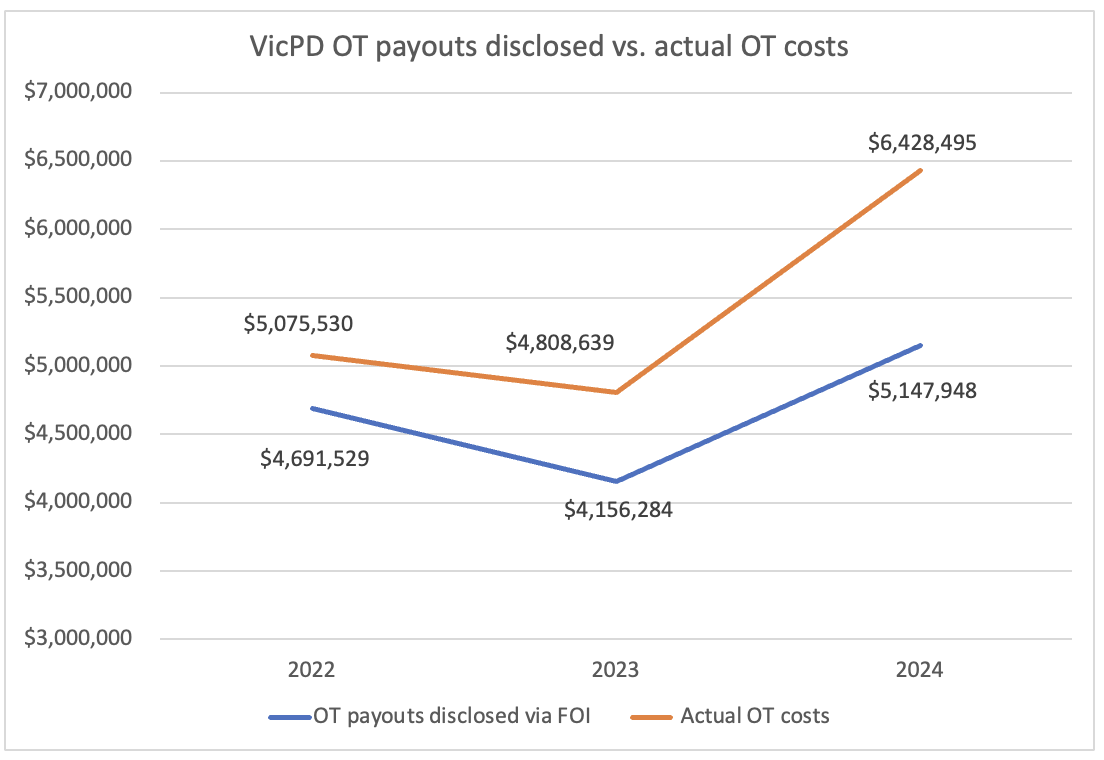
Why the discrepancy? OT for non-officers is separate in VicPD’s budget documents, so that’s not it. And while the province pays VicPD back for OT at Legislature protests, and they recoup some additional OT costs elsewhere (VicPD reported $2.8 million in recovered OT costs in 2024), that money still goes to the officers, so leaving it off doesn’t make sense. Moreover, that recouped OT is listed in VicPD’s budgets, and the totals don’t account for the difference.
There may be a simple explanation. I asked VicPD if they could clarify and they said they would look into it, but I haven’t heard back yet. I’ll update this post if I do.
In the meantime, in the words of Electric Six, “the numbers don’t add up.”
Update: VicPD informed CHEK the discrepancy is because the OT figures in the budget documents also include payouts for “standby” pay, when officers are on call. In the FOI data, those standby payouts are rolled into the base remuneration column. Even though VicPD had the answer, a couple of hours after CHEK told me VicPD’s explanation to ask for my comment, VicPD emailed me to say they “cannot reply to specific questions about the data” to explain the discrepancy. They said I was “welcome to submit another FOI request.”
OT is expensive. It’s also not needed.
There is no officer shortage in Victoria and Esquimalt that necessitates this level of overtime. VicPD has the third-most officers per capita in the country after Thunder Bay and Montreal, and more officers per capita than 82% of U.S. cities. To bring VicPD down to the Canadian national average, they would have to cut 79 officers from their existing complement.
We know VicPD is cavalier in how they hand out overtime. Earlier this year, VicPD was caught paying officers $4,100 in OT to attend Del Manak’s retirement party at Government House.
Much like police shouldn’t be paid overtime to attend a party, there is similarly no need for dozens of officers to mill about at protests and events. Because the province pays VicPD back for OT costs it bills for Legislature protests, VicPD has paid officers millions in overtime over the years that it never has to fully justify to the police board or city councillors, because someone else is footing the bill.
Officer caseload, another thing VicPD likes to cite to justify its costs, is also not a given. We can build a different world where police do not insinuate themselves in mental health calls, for example, and where we invest money in community supports that actually keep people safe.
Over policing comes with financial costs, but it also puts people at risk.
When VicPD chooses to send up to a dozen or more officers to mental health calls, they often do more harm than good. VicPD officers threaten to shoot someone every three days, use force against people at least twice a day, and injure someone every 2.5 days.
And some officers are earning overtime while they do it.
Download the data
Note that the “Remuneration” column includes overtime pay.
Spreadsheet with some added columns and totals: Download here.
Data as it was sent to me in PDF: Download here.
File an FOI for your own department
Much like I took this FOI idea from Liam Britten, you can replicate it for your local department, too!
Your mileage may vary, but here’s what I asked for. You could also reword it slightly to try to get year-over-year data for individual officers.
For each of the years 2022, 2023, and 2024, a spreadsheet with columns for: 1. Position titles for each individual sworn officer; 2. Total remuneration (including overtime) paid to that officer; and 3. Overtime paid to that officer. For example, in a spreadsheet for 2023, a row for one officer might note in Column 1 that they were a constable; in Column 2 that they received $XX in total remuneration in 2023; and in Column 3 that they were paid $YY in overtime in 2023.